Hi, welcome back to our blog! Today we will talk about types of color blindness.
So, firstly in order for us to see all the things, we need a little helper in our eyeballs called photoreceptors. there are two types of them which are rods and cones. Both of them are located on the retina and and transfer information on to our brain. There are about 120 million rods which are very sensitive to light but not to color. There are about 6 to 7 millions of cones that are responsible for our color vision.
Each of those cones is carrying one out of three different photopigments and therefore reacts differently on colored light sources. For each of this three types there exists a specific color absorption curve with peaks at different points in the color spectrum.
- S-cones: sensitive to short wavelength light with a peak at ca. 420nm (blue)
- M-cones: sensitive to medium wavelength light, peak at ca. 530nm (green)
- L-cones: sensitive to long wavelength light, peak at ca. 560nm (red)
Mixing together the information of those three different types of cones makes up our color vision. This is also the reason that only three main colors are needed if we want to mix together all visible colors, because we only have three sources of information for mixing our whole color spectrum.
- Monochromatism: Either no cones available or just one type of them.
- Dichromatism: Only two different cone types, the third one is missing completely.
- Anomalous trichromatism: All three types but with shifted peaks of sensitivity for one of them. This results in a smaller color spectrum.
Dichromats and anomalous trichromats exist again in three different types according to the missing cone or in the latter case of its malfunctioning.
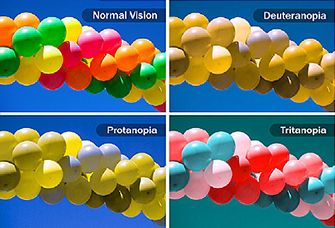
- Tritanopia/Tritanomaly: Missing/malfunctioning S-cone (blue).
- Deuteranopia/Deuteranomaly: Missing/malfunctioning M-cone (green).
- Protanopia/Protanomaly: Missing/malfunctioning L-cone (red).
To be more specific, there are 3 types of colour blindness which are:-
Red Green Color Blindness
- Protanomaly is caused by defective L-cones, lowering sensitivity to red hues.
- Protanopia is caused by absent L-Cones, removing the ability to see reds – a severe form of color blindness.
- Deuteranomaly is caused by defective M-cones, weakening the ability to differentiate red and green hues in as much as 5% of all males.
- Deuteranopia is caused by absent M-cones, giving a moderate inability to discriminate red – green hues.
Blue Yellow Color Blindness
- Tritanomaly is caused by weakened S-cones, reducing the ability to distinguish some blue and yellow hues.
- Tritanopia is extremely rare, resulting from a total absence of S-cones. Removing the ability to distinguish some blues with green, and some yellows with violet.
Total Color Blindness
- Rod monochromacy is a rare, non progressive inability to distinguish any color, resulting from non functioning or absent retinal cones. Rod monochromacy is typically associated with sensitivity to light (Photophobia) and poor vision.
- Cone monochromacy is also a rare, total color blindness, however is accompanied by relatively normal vision.
That's all for today! Have a nice day everyoneeeee :)

No comments:
Post a Comment