Sunday, November 11, 2018

Who Are at Risk of Color Blindness?

Hello there readers! We welcome you back for an update of this blog, today I will explain regarding the risk factors of color blindness. Mainly the risk factors can be either genetically or even acquired. Below will be some further explanation about the topic.  

Most individuals with color deficiency are born with it. Congenital color blindness is usually inherited as a genetic trait passed down from mother to son. A mother who carries one normal X chromosome and one X chromosome with a mutation of red and/or green pigments is not affected, but her son has a 50 percent chance of having a color vision deficit. Fathers cannot pass it to their sons, because they supply only a Y chromosome to the genetic mix, but they can pass the gene to their daughters who carry the gene but do not manifest a color deficit. For a woman to inherit a color vision deficiency, she must have a mother who is a carrier and a father who is color deficient. The odds of this occurring are very slim. That explains why males are much more likely than females to inherit color deficiency, experiencing color blindness from birth. An estimated one in ten males has some form of color deficiency.

Color blindness, however, can develop as the result of disease, medical conditions, trauma, or as a side effect of medication. Conditions that may lead to color blindness includes :
  • Glaucoma
  • Parkinson's disease
  • Alzheimer's disease
  • Leukemia
  • Sickle cell anemia
  • Macular Degeneration
  • Alcoholism
Certain drugs may also increase the risk for acquiring color blindness. The drug hydroxychloroquine (Plaquenil) can cause color blindness. It is used to treat rheumatoid arthritis, among other conditions.

Color Blindness Inheritance

Thursday, November 8, 2018

Treatment of Color Blindness

Hello! Welcome back to our blog. Today we will be discussing regarding the treatments of color blindness.

   Inherited colour blindness is usually  not treatable. In cases of acquired colour blindness, a doctor will treat the underlying disease or injury. People with mild colour blindness lead fairly normal lives. 99% of color blind males and females are color blind as a result of defective genetics on the X chromosome. To cure this color blindness would require some form of gene therapy, repairing the damaged chromosome. 

   However even this is only educated circumspection, there is no scientific method available at present that shows any signs of promise of a cure for color blindness.Besides in some cases,  red-colored lenses can help reduce sensitivity to light for people with colour blindness. Moreover a device called an eyeborg can help people with achromatopsia perceive color through sound waves.Acquired color blindness can be corrected by treatments such as prescribed medications, color corrective glasses and color corrective contact lenses. One of the treatment are Colorist System which  help people who are colour blind.These Colorist Systems can be worn as either contact lenses or spectacles. This gives colour blind people a whole new world of colour in their life. Colorist Systems can include Chromagen lenses, ColorMAX, Colorlite, Colorview and more.


Chromagen lenses for color blindness


Spectacles for color blindness
                               

Wednesday, November 7, 2018

How to Diagnose Color Blindness?


Inherited color vision deficiency is usually diagnosed in early childhood using a simple screening tests. The Hardy-Rand-Rittler (H-R-R) and Ishihara Color Plates are used to evaluate the type and degree of color deficiency. In these tests, the person is asked to identify the colored shapes or numbers that lie within a jumble of dots and vary in color and intensity. The physician detects and categorizes the deficiency based on the person’s responses.


Hardy Rand Rittler test


Ishihara test


Wednesday, October 31, 2018

Causes of Color Blindness


1. Genetic

The human eye has three sorts of cone cells, with every one detecting red, green or blue light. These cones are found in macula, which is connected to the main part of retina.

For people who inherit the color blindness, typically, either one of these cone cells are not working properly. The gene responsible is on X chromosome.


 2. Acquired

  •      Such as physical or chemical damage to the eye
  •      Damage to optic nerve
  •      Cataract
  •      Age
  •      Damage to parts of the brain that process color formation
  •      Side effects some medicine


Saturday, October 27, 2018

Types of Colour Blindness

Hi, welcome back to our blog! Today we will talk about types of color blindness.


So, firstly in order for us to see all the things, we need a little helper in our eyeballs called photoreceptors. there are two types of them which are rods and cones. Both of them are located on the retina and and transfer information on to our brain. There are about 120 million rods which are very sensitive to light but not to color. There are about 6 to 7 millions of cones that are responsible for our color vision. 


Each of those cones is carrying one out of three different photopigments and therefore reacts differently on colored light sources. For each of this three types there exists a specific color absorption curve with peaks at different points in the color spectrum.
  • S-cones: sensitive to short wavelength light with a peak at ca. 420nm (blue)
  • M-cones: sensitive to medium wavelength light, peak at ca. 530nm (green)
  • L-cones: sensitive to long wavelength light, peak at ca. 560nm (red)
Mixing together the information of those three different types of cones makes up our color vision. This is also the reason that only three main colors are needed if we want to mix together all visible colors, because we only have three sources of information for mixing our whole color spectrum.
  • Monochromatism: Either no cones available or just one type of them.
  • Dichromatism: Only two different cone types, the third one is missing completely.
  • Anomalous trichromatism: All three types but with shifted peaks of sensitivity for one of them. This results in a smaller color spectrum.
Dichromats and anomalous trichromats exist again in three different types according to the missing cone or in the latter case of its malfunctioning.
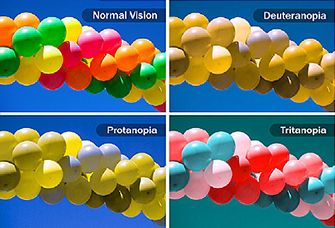
  • Tritanopia/Tritanomaly: Missing/malfunctioning S-cone (blue).
  • Deuteranopia/Deuteranomaly: Missing/malfunctioning M-cone (green).
  • Protanopia/Protanomaly: Missing/malfunctioning L-cone (red).
To be more specific, there are 3 types of colour blindness which are:-

Red Green Color Blindness


  • Protanomaly is caused by defective L-cones, lowering sensitivity to red hues.
  • Protanopia is caused by absent L-Cones, removing the ability to see reds – a severe form of color blindness.
  • Deuteranomaly is  caused by defective M-cones, weakening the ability to differentiate red and green hues in as much as 5% of all males.
  • Deuteranopia is caused by absent M-cones, giving a moderate inability to discriminate red – green hues.

Blue Yellow Color Blindness

  • Tritanomaly is caused by weakened S-cones, reducing the ability to distinguish some blue and yellow hues.
  • Tritanopia is extremely rare, resulting from a total absence of S-cones. Removing the ability to distinguish some blues with green, and some yellows with violet.

Total Color Blindness

  • Rod monochromacy is a rare, non progressive inability to distinguish any color, resulting from non functioning or absent retinal cones. Rod monochromacy is typically associated with sensitivity to light (Photophobia) and poor vision.
  • Cone monochromacy is also a rare, total color blindness, however is accompanied by relatively normal vision.

Image result for types of colour blindness


That's all for today! Have a nice day everyoneeeee :)

Monday, October 22, 2018

What is Color Blindness?

Hello guys! Welcome back to our blog hihi, how was your day? Was it good? We hope that everything goes well for you💕 So, have you guys ever wondered, what is color blindness actually and how does it occur? Well, not to worry, today we will share with you some new informations regarding color blindness.

Mostly everyone share a common color vision sensory experience but there are some people that have a color vision deficiency. This color blindness is definitely not a form of blindness. However, their perception of colors is different from what the normal people see. They will have a difficulty to determine certain colors such as blue and yellow or red and green. Statistic shows that the color blindness affects approximately 1 in 12 men and 1 in 200 women in the world. Usually, people with color blindness are not aware of the differences among colors that are obvious to the normal people. Sometimes, they are not even aware of their condition unless they are tested in a clinic or laboratory. This color blindness can be caused by physical or chemical damage such as to the eye, the optic nerve or parts of the brain that process color information.


Friday, October 19, 2018

Hello (:

Hi everyone😇 Welcome to our blog! We are a group of 6 students taking Bachelor in Medical Science from Management and Science University. First of all, we would like to extend our sincere gratitude and appreciation to Dr Arffah for all the hard work and for giving us the opportunity to share this information regarding color blindness. This blog is a part of our assignment for Genetic Disorder subject. Therefore, we hope that this blog would help to share the informations regarding color blindness to the society. Stay tuned for our further information! xoxo